
How an Orchard Turned Livestock Waste into Energy and Fertiliser? – A Case Study from Shaanxi, China
A 280 m³ digester, a 200 m³ gas holder, and 70,000 m³ of biogas per year – this system cost approximately USD 520,000. It turns livestock manure from surrounding farms into electricity, heat, and fertiliser, generating 120,000 kWh of power and 1,600 tonnes of organic fertiliser annually. Here’s how the numbers work out.
From Manure to Biogas – The Complete Anaerobic Digestion & Gas Storage Process
For any farm, manure disposal is costly, and non-compliance carries regulatory risk. The concept is simple: turn the cost of waste treatment into revenue from energy and fertiliser.
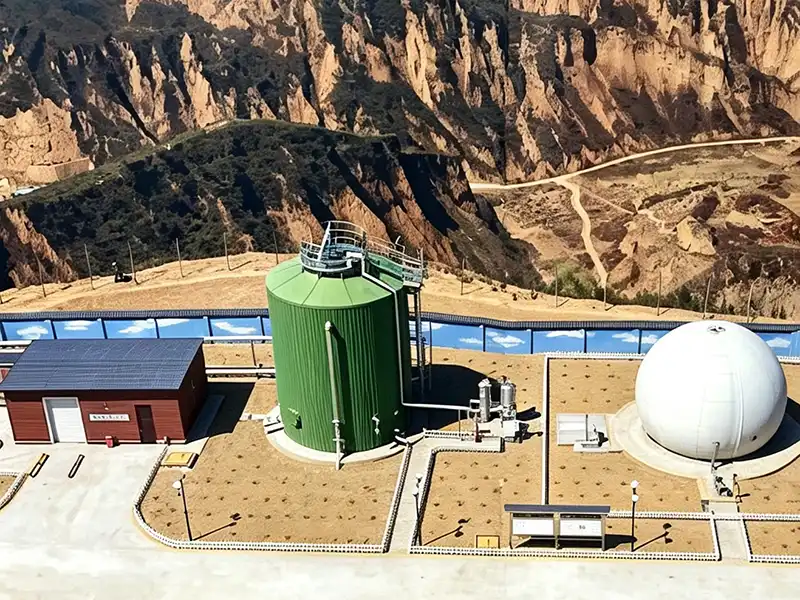
The system collects livestock manure from surrounding farms and feeds it into a 280 m³ anaerobic digester. Microorganisms break down the organic matter without oxygen, producing biogas. The biogas is stored in a 200 m³ double membrane gas holder, then used for power generation and heating. The remaining digestate – solid and liquid fractions – is applied to the orchard as organic fertiliser.

Biogas Project Investment – Digester, Gas Holder & Performance Data
Investment
- Total project cost: RMB 3.8 million (approximately USD 520,000)
- Footprint: 4 mu (approx. 2,670 m²)
- Key equipment: 280 m³ anaerobic digester + 200 m³ double membrane gas holder
Output
- Annual manure processed: 1,800 tonnes – equivalent to the waste output of a medium-sized livestock farm
- Annual biogas production: 70,000 m³ → 120,000 kWh of electricity (enough to power 30–40 homes for a year)
- Annual organic fertiliser: 100 tonnes of solid digestate + 1,500 tonnes of liquid digestate (replacing chemical fertilisers, improving soil health)
- Annual carbon reduction: approximately 800 tonnes CO₂ equivalent
Biogas Power, Gas Storage Buffering & Waste-to-Fertiliser – Where Does the Payback Come From?
The payback comes from four areas, each delivering real savings:
- Electricity savings: 120,000 kWh/year of self-generated power. Your local electricity rate will determine the actual savings (reference range: USD 0.08–0.15/kWh).
- Fertiliser replacement: 1,600 tonnes/year of digestate replacing chemical fertilisers. Your local fertiliser prices will determine the actual savings (reference range: USD 80–120/tonne).
- Manure disposal savings: 1,800 tonnes/year of manure that no longer needs off-site treatment. Your local waste treatment rates will determine the actual savings (reference range: USD 20–40/tonne).
- Heat recovery: Waste heat from the generators is recovered for system heating and facility warming, reducing additional fuel costs.
- How to calculate your return: Add the four items above to estimate your annual return. Actual figures will vary with local energy and fertiliser prices. Contact us for a detailed ROI assessment tailored to your project.
Risk Mitigation & Additional Benefits
- Environmental compliance: Eliminates the risk of penalties from untreated waste discharge.
- Energy independence: Shielding from grid price volatility and rising fuel costs.
- Soil improvement: Long-term organic fertiliser application enhances fruit quality and yield.
- Carbon credit potential: 800 tonnes CO₂e/year could potentially generate carbon credits through voluntary carbon markets, subject to certification (compliance with local carbon market rules and project-specific verification required).
Is Anaerobic Digestion & Gas Storage Technology Reliable? – A Proven Process?
- The system uses mesophilic anaerobic digestion – one of the most proven biogas technology routes worldwide.
- The digester is equipped with a high-efficiency mixer on top, with installed power of less than 5W/m³ of tank volume – over 30% more energy-efficient than traditional mixers.
- The double membrane gas holder is a lightweight, corrosion-resistant gas storage device made of three membrane layers. Compared with traditional steel gas holders, it offers lower capital cost, quicker installation, no need for anti-corrosion treatment, and a service life of 10+ years.
- Projects of similar scale have been successfully implemented on farms in the U.S. Midwest, on small dairy farms across Europe, and in many other regions – the technology is mature with a proven track record.
Can This Model Be Replicated?
Yes. The system is moderate in scale with a small footprint, making it particularly suitable for:
- Farms with a steady manure supply – either from their own farm or from neighbouring farms.
- Orchards or farms with cropping needs – requiring organic fertiliser to replace chemicals.
- Regions with high electricity costs or unreliable grid supply – where self-generation offers clear economic benefits.
- Key prerequisites: A consistent manure supply (1,800 tonnes/year, roughly equivalent to the waste from 300–500 cattle) + sufficient land for digestate application.
About the Core Equipment: Double Membrane Gas Holder
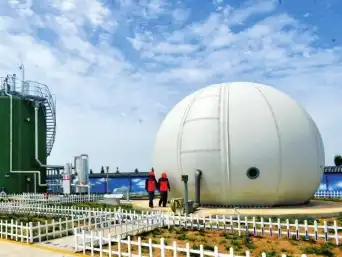
The 200 m³ double membrane gas holder used in this project is a lightweight, corrosion-resistant gas storage device, ideal for small to medium-sized biogas systems.
It consists of three membrane layers – an inner layer that stores the gas, an outer layer that maintains the spherical shape, and a bottom layer that ensures sealing. Compared with traditional steel gas holders, the double membrane design offers lower capital cost, quicker installation, no need for anti-corrosion treatment, and a service life of 10+ years.
Project status: Operational
This case study is based on a real project in Shaanxi, China. All data are for reference only.